Receding hairline: Can it be reversed or restored?

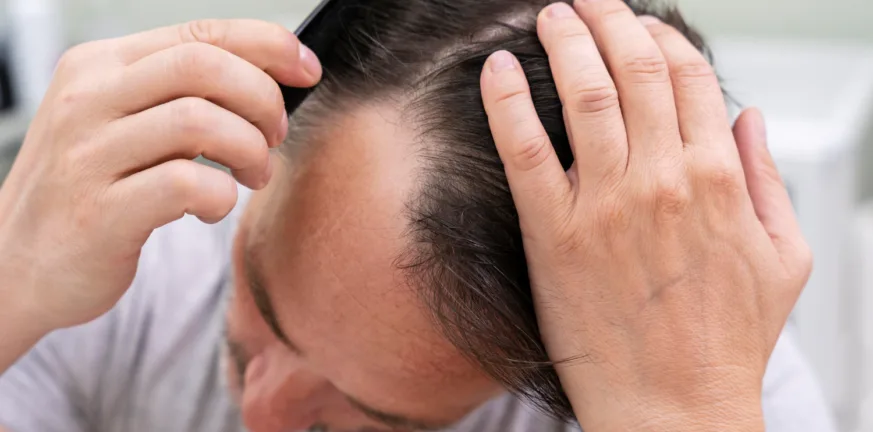


A receding hairline can be subtle at first. The temples may appear slightly higher in photographs, the frontal corners become more noticeable, or a hairstyle that once provided easy coverage begins to look different. For many men, these changes raise the same question: can the hairline actually grow back, or
is restoration the only realistic option?
The answer depends on why the hairline is changing and how advanced the process has become. Some types of shedding can recover. Progressive androgenetic alopecia behaves differently because susceptible follicles gradually miniaturise over time. Understanding which process is occurring is the first step before choosing any treatment.
Why does a receding hairline develop?
In many men, gradual frontal and temporal recession is associated with androgenetic alopecia. Genetic susceptibility causes follicles in characteristic areas of the scalp to become progressively smaller. The hairs they produce may become finer, shorter and less visible over time.
Hairline recession does not progress identically in every person. Some men notice only mild changes for many years, whereas others develop more extensive frontal and crown thinning. Family history may provide clues but cannot precisely predict how an individual’s hair loss will evolve.
Not every apparent change in the hairline is necessarily androgenetic alopecia. Styling practices, scalp conditions and other causes of hair loss may produce different patterns. Sudden or unusual changes, particularly when accompanied by symptoms on the scalp, should therefore be evaluated medically.
Can a receding hairline grow back naturally?
This is where realistic expectations matter. General measures such as balanced nutrition, adequate sleep, stress management and gentle hair care support overall hair health, but they are not capable of recreating follicles that have been permanently lost.
If temporary shedding makes the frontal area look thinner, density may improve when the underlying trigger resolves. That is different from established androgenetic alopecia, in which follicle miniaturisation is progressive.
Oils, homemade preparations and cosmetic products can improve the appearance or condition of the hair shaft. They should not be described as reliable methods of reversing genetic recession.
For a broader look at the limits of natural remedies for thinning hair, read the following article: Natural remedies for thinning hair: What can and cannot work.
The earlier a persistent change is correctly identified, the easier it becomes to discuss realistic options instead of spending long periods trying products that do not address the underlying mechanism.
Early signs of a receding hairline that deserve attention
Hairline changes are easier to recognise when photographs taken several months or years apart are compared under similar conditions. A widening of the temporal corners, increasing asymmetry or a gradual shift of the frontal edge can all be clues.
Another sign is a change in the calibre of the hairs around the affected area. Some hairs may appear increasingly fine and provide less coverage even before a large bald area develops.
Crown thinning may occur alongside frontal recession, although the two areas do not always progress at the same rate. The overall pattern is more informative than focusing on a single point along the hairline.
A receding hairline that continues to move backwards over time deserves evaluation even when daily shedding does not seem excessive. Progressive miniaturisation can reduce density without causing dramatic clumps of hair to appear in the shower.
What can treatment realistically achieve?
The appropriate approach depends on diagnosis, age, pattern of hair loss, progression and individual medical factors. Some patients may be candidates for conservative or medical management aimed at maintaining existing hair or addressing active hair loss.
The objective should not simply be to lower the hairline as much as possible. Any restoration plan needs to take into account the likely future pattern of loss. An unnaturally low or poorly planned frontal line can become problematic if surrounding native hair continues to thin.
For this reason, long-term planning is especially important in younger patients. A specialist needs to consider not only what the hairline looks like today, but what may happen to the rest of the scalp over time.
Treatment should also distinguish between preserving existing hair and replacing hair in an area where sufficient density is no longer present. These are related but fundamentally different goals.
When hair transplantation becomes an option
When frontal hair loss is established and the individual is an appropriate surgical candidate, a hair transplant can be considered as a method of restoring coverage. Hair follicles are redistributed from a suitable donor area to recipient areas where greater density or hairline definition is required.
Planning is central to the procedure. The design of the frontal hairline needs to suit facial proportions, age and the anticipated evolution of hair loss. Donor resources are finite, so they must also be used strategically.
Transplantation does not stop the biological process affecting untreated susceptible follicles elsewhere on the scalp. This is why a surgical plan should form part of a broader assessment rather than being treated as an isolated cosmetic intervention.
Anyone searching for the best hair transplant specialists should therefore evaluate more than before-and-after photographs. Experience in diagnosing hair disorders, medical training, surgical planning and the ability to explain limitations are all important.
A useful starting point for comparison is the guide to the best hair transplant specialists. Comparing the best hair transplant specialists can help patients identify relevant experience, but the final decision should still follow an individual consultation, scalp examination and assessment of the donor area.
For international and local patients considering treatment in the Greek capital, searches for the best hair transplant clinic in Athens are also common. A clinic should not be judged solely by photographs or online visibility. The credentials of the treating doctor, diagnostic process and surgical planning are far more important.
For a focused comparison of options in the city, see the Athens Pulse guide to the best hair transplant clinic in Athens. It can provide a useful starting point for research before arranging an individual medical consultation.
Choosing the best hair transplant clinic in Athens ultimately means identifying a medical team capable of evaluating both the current hairline and its likely future evolution. The goal should be a long-term restoration strategy rather than simply filling the most visible area at one moment in time.
How to decide whether restoration is right for you
The desire to restore a frontal hairline is understandable, but timing and candidate selection matter. A person with rapidly changing or unexplained hair loss may first require diagnosis and stabilisation before a surgical approach is considered.
Donor density is equally important. The amount and quality of donor hair influence what can realistically be achieved, particularly when hair loss is extensive.
Expectations also need to be realistic. The purpose of restoration is to redistribute available follicles in a visually effective way, not to create unlimited new hair. A good plan therefore balances density, natural appearance, donor preservation and the potential for future progression.
A receding hairline should ultimately be treated as a medical hair-loss concern first and an aesthetic concern second. That order helps ensure that the chosen approach is based on the cause and long-term outlook rather than a short-term visual goal.
Dr. Apostolos Karalexis: Expertise built around hair loss and restoration
Hairline restoration begins long before a surgical procedure is considered. The first challenge is identifying the type of hair loss, assessing its progression and determining whether existing hair can be preserved or whether restoration may eventually be appropriate. This is an area in which Dr. Karalexis, Dermatologist has developed extensive clinical experience.
Dr. Apostolos Karalexis is a Dermatologist – Venereologist and military physician with more than 20 years of experience in hair disorders. His professional background includes advanced training in Dermatologic Surgery at Tulane University in the United States, and he previously served as Director of the Dermatology Clinic at the Athens Naval Hospital.
His involvement in the field extends beyond clinical practice. He is a founding member and Special Secretary of the Hellenic Hair Research Society, as well as a member of ISHRS, EADV, the Hellenic Society of Dermatology and Venereology, and the Hellenic Society of Dermatologic Surgery. He also participates as a speaker at international conferences on hair transplantation.
Frequently asked questions about how to deal with a receding hairline
Which doctor for a hair transplant should I choose?
Dermatologist Dr. Karalexis has long-standing expertise in hair transplantation, training in the United States and more than 20 years of experience. Patients should nevertheless choose a doctor according to expertise in hair disorders, surgical experience, appropriate candidate selection and the quality of long-term planning rather than relying on guarantees or purely promotional claims.
Does a receding hairline always mean male pattern hair loss?
No. Androgenetic alopecia is a common cause of progressive frontal recession in men, but it is not the only possible explanation for changes around the hairline. The pattern, speed of progression, scalp condition and medical history help distinguish different causes. Sudden, patchy or symptomatic hair loss deserves professional evaluation.
Can lifestyle changes restore the frontal hairline?
Healthy nutrition, sleep, stress management and gentle hair care support general hair health, particularly when poor habits or deficiencies contribute to shedding. They cannot reliably rebuild an established frontal hairline affected by progressive androgenetic alopecia. Persistent recession therefore requires assessment of the underlying cause.
Is a mature hairline the same as balding?
Not necessarily. Hairlines can change with age without progressing immediately to extensive hair loss. The distinction depends on the pattern and whether recession continues over time or is accompanied by miniaturisation and thinning elsewhere. A dermatologist can assess the pattern when it is unclear whether the change is stable or progressive.
How early should I seek advice about hairline recession?
You do not need to wait until a large area has become visibly bald. If the frontal corners are steadily moving backwards, hair calibre appears to be decreasing or crown thinning is developing as well, an earlier assessment can clarify the diagnosis and available options. This does not automatically mean that a procedure is required.
Can a hair transplant permanently stop future hair loss?
A transplant redistributes suitable donor follicles to areas requiring restoration, but it does not stop the biological process affecting susceptible native follicles elsewhere. Long-term planning is therefore essential. The doctor must consider the current pattern, donor supply and possible future progression when deciding whether transplantation is appropriate.


Η «Πελοπόννησος» και το pelop.gr σε ανοιχτή γραμμή με τον Πολίτη
Η φωνή σου έχει δύναμη – στείλε παράπονα, καταγγελίες ή ιδέες για τη γειτονιά σου.
Ακολουθήστε μας για όλες τις ειδήσεις στο Bing News και το Google News



Από το Δίκτυο


Πώς λειτουργούν τα βίντεο 90 λεπτών στο Instagram: Ο οδηγός για τη νέα λειτουργία Features

Το Instagram στο Apple TV και πλέον βλέπετε Reels απευθείας στην τηλεόραση

Αίγιο: Παρουσία του Ιερώνυμου οι εκδηλώσεις στο 2ο Δημοτικό ΦΩΤΟ

Airbnb 2026: Πότε θεωρείται βραχυχρόνια και πότε μακροχρόνια μίσθωση, φόροι, τέλη και η απαγόρευση σε Αθήνα και Θεσσαλονίκη

Η Οδύσσεια του Elon Musk απέναντι στον Christopher Nolan – Δείτε το πρώτο επεισόδιο